On Patriotism
This is a politically sensitive topic. Why write about it? I have always disliked discussing politics, unless it has deeply and directly affected my personal life.
Background
Lately, boycotts of “Country X” products and foreign fast-food chains have been popping up one after another, all under the banner of “patriotism.” In reality, many of these brands are highly localized, and their taxes and employment figures have already contributed directly to our “Great Celestial Empire” (大天朝). From a rational perspective, these boycotts are completely pointless. Yet, it is only now that various state media outlets are stepping up to advise people to remain rational. Something feels off here. Who was it that previously used all kinds of patriotic rhetoric to fan the flames of public emotion in the first place? Waiting until now to lock the stable door after the horse has bolted feels incredibly hypocritical.
Definition
Let’s dissect the concept of “patriotism.” Patriotism is something drilled into us from childhood through patriotic education. The official definition (from Baidu Baike) is as follows:
Patriotism refers to a positive and supportive attitude of an individual or group toward their homeland, and is one of the civic virtues an individual should possess.
Patriotism is the positive and supportive attitude of an individual or collective toward the “homeland.” This “homeland” can be a region or a city, though patriotism is generally applied to a nation or federation. Loving the homeland means loving its people, whereas the state is manifested directly in its political regime; the homeland and the state are not the same thing. Citizens should love their homeland, and the state should be loyal to its citizens. This is the fundamental reason why revolutionary pioneers like Sun Yat-sen and He Ziyuan are still revered as patriots even though they overthrew the Qing dynasty. A change of dynasty is merely a change of state; the destruction of culture is the destruction of the world under heaven (“亡天下”). As the saying goes, “The rise and fall of the nation is the responsibility of every individual.” As long as the culture survives, China survives. To be patriotic is to love the culture, which means protecting traditional Chinese culture.
The Wikipedia definition is as follows:
Patriotism is an ideology that evokes patriotic sentiment to drive collective action or political mobilization, in opposition to globalism. It is often discussed alongside nationalism. The historical development of nationalism after the 19th century transformed the meaning of classical patriotism inherited from 18th-century Enlightenment thought.
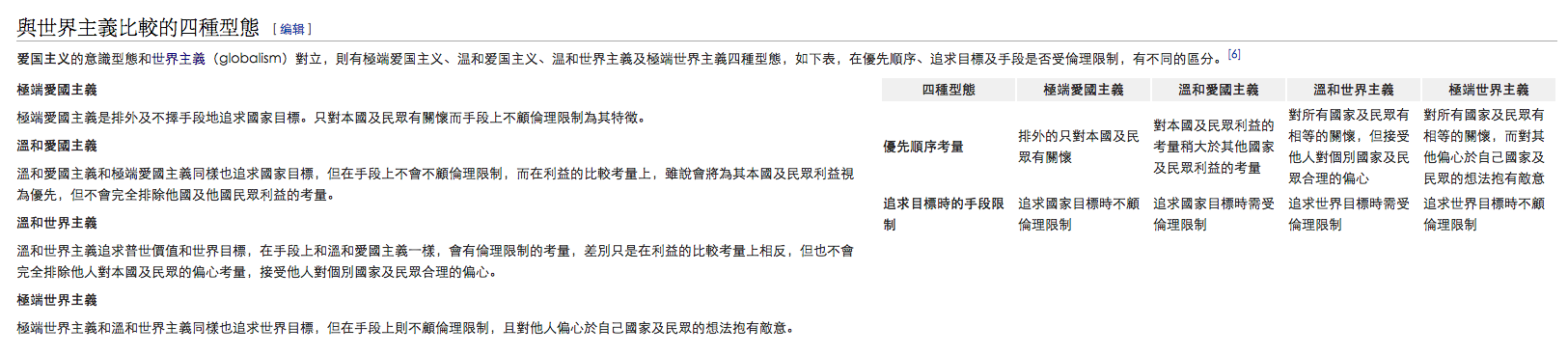
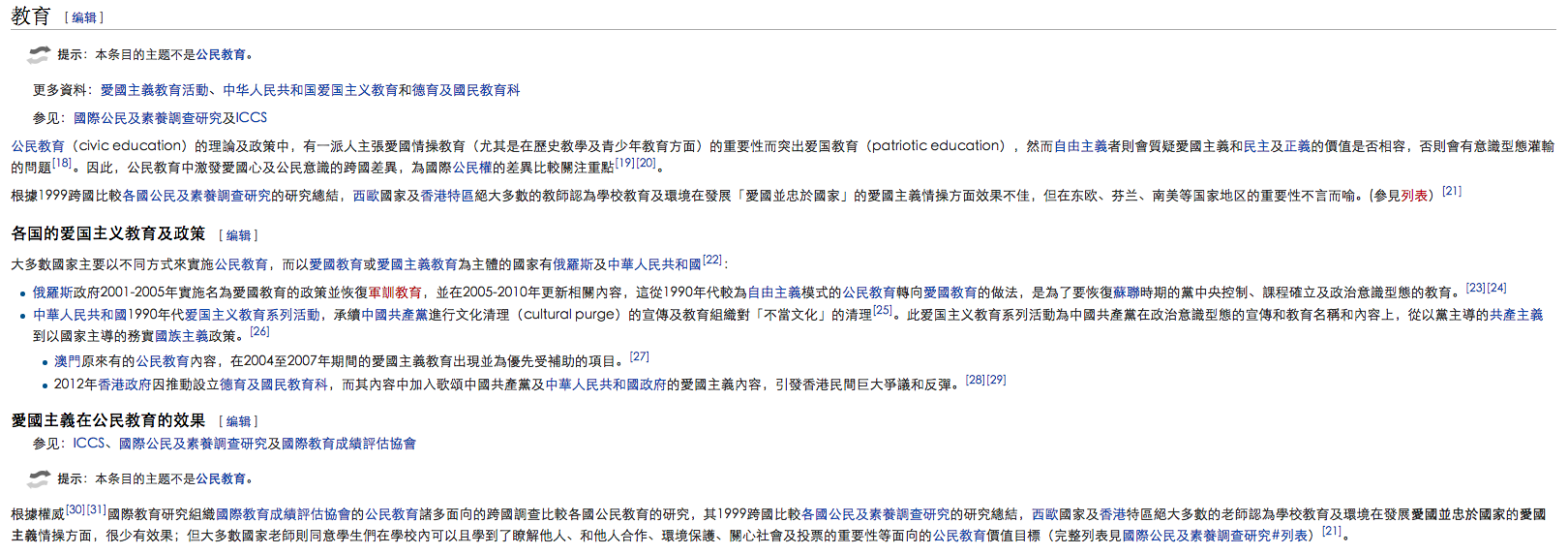

Putting aside who is right and who is wrong for a moment, as anyone reading the above definitions will form their own opinions. Let’s analyze the purpose of patriotism: is it a tool for the government to maintain its rule, or a path to safeguard the collective interests of the nation (or its people)? Obviously, state media completely omits these political implications and purposes.
To put it simply, does patriotism guide your behavior to turn you into a political tool for the government, or does it inspire you to do things that truly benefit the citizens? Judging by recent mass incidents, it is clearly the former. Fortunately, the government seems to have realized this and can no longer easily “dupe” the public this way, which is why they are now calling for calm and “rational patriotism.” Why? In the past, we were a relatively isolated economy; fanning the flames of patriotic outrage had little impact on the domestic economy. But now, we are fully integrated into the global economy, with deep cooperation and integration. Behaving like this now directly harms our own national interests. Naturally, the official narrative shifted overnight.
Looking back, how many foolish things have we done? Fortunately, our generation is not one that can be easily brainwashed by the authorities. Through the internet and diverse media, we have heard different voices and observed things from various angles. We no longer live in an era where we are passively fed a single narrative by the evening news (Xinwen Lianbo). Stripping away all the “-isms,” we have basic human values to judge right from wrong. It’s not as simple as “this is right just because you taught me so.” Besides, nobody possesses an absolute monopoly on truth.
To be absolutely realistic, wise leaders are those who protect their citizens’ livelihoods and allow them to pursue and fulfill a better quality of life—regardless of democracy or governing ideologies. From this perspective, there is really no need to force-feed patriotic education to the next generation, because in plain terms, it is nothing but a form of obscurantism (愚民教育). I now completely understand why Hong Kong fiercely boycotted this curriculum years ago. Unless we choose to retreat into isolation again, internationalization will inevitably make information more transparent and society fairer. If you are not prepared for that, so be it. But please, stop deceiving these kind-hearted citizens.
I genuinely have no desire to debate politics, as it doesn’t interest me. But I do care about my life. I hope everyone can cast aside irrational emotions and focus on their own lives, rather than letting themselves be manipulated as tools by certain interest groups.